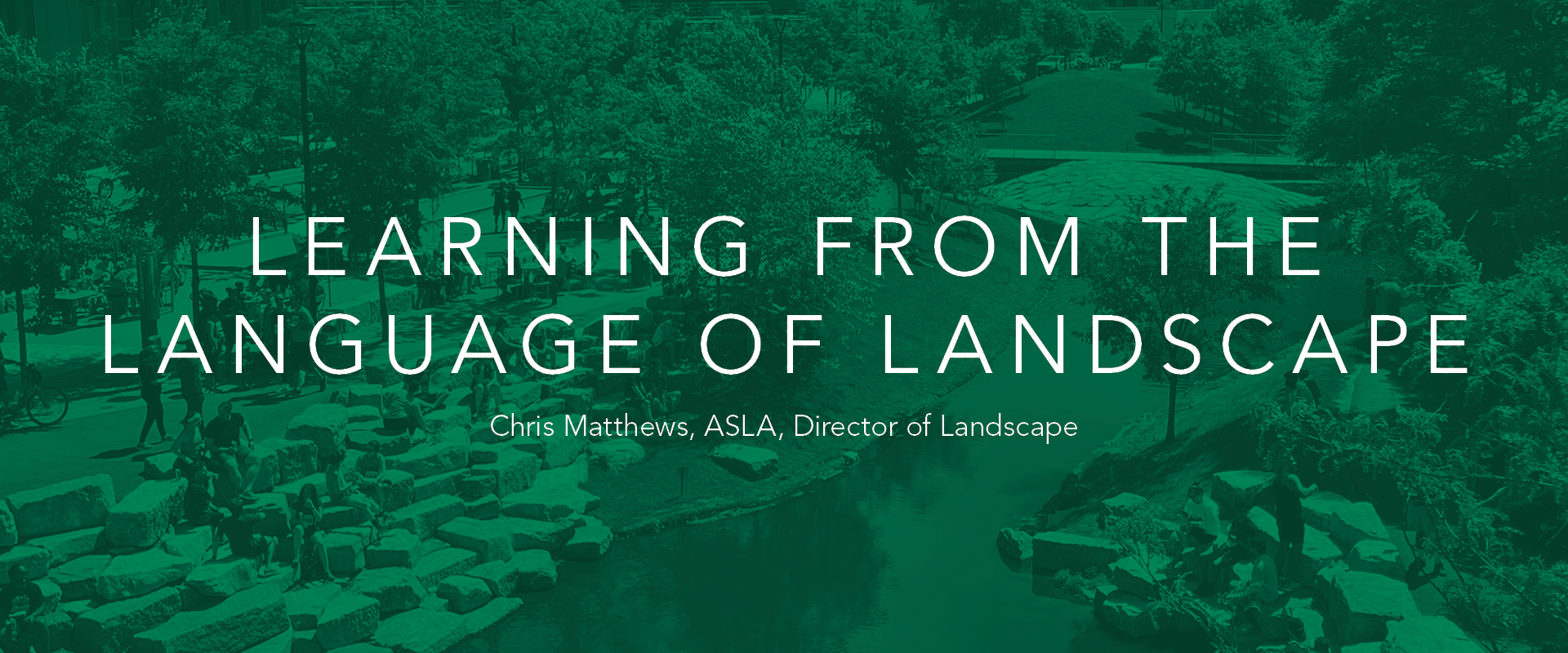
Learning from the Language of Landscape
By: Chris Matthews, ASLA, Director of Landscape
Walk into almost any design office today and before long the conversation will turn to artificial intelligence. Some people are excited. Others are apprehensive. Most of us are somewhere in between, wondering what these extraordinary new tools will mean for our profession. The discussion usually revolves around productivity. AI will help us draw faster, generate more options, analyse data, produce renderings and automate countless routine tasks. All of that is undoubtedly important.
But I wonder if we are asking the wrong question. Perhaps the most interesting question is not how AI will change the way we design but how AI might change the way we experience the real world—outdoors away from the screen, rather than indoors captivated by it.
Over nearly four decades of practice in London, Tokyo and Boston, I have been fortunate to work in places with very different cultures, landscapes and urban traditions. Yet despite those differences, I have found myself returning to the same questions. Whether working on the quiet intimacy of a garden, the complexity of the largest new urban park in the world, or the long-term growth of an emerging national capital, I remain consumed by imagining and realizing beautiful landscapes, but find myself increasingly interested in the beauty of the experiences that landscapes, man-made, natural, or somewhere in between, make possible.

Whether I am walking through a Hertfordshire village, exploring woodland trails on Cape Cod, catching my breath in Meiji Shrine’s dazzling iris garden in Tokyo, wandering through the unfolding classical stories of Stourhead, or working with colleagues on the future growth of Abu Dhabi, I find myself asking remarkably similar questions: Why does one place invite us to slow down? Why does another encourage us to keep moving? Why do some places remain with us for decades while others disappear from memory almost as soon as we leave?
The longer I work with the living medium of landscape, the more I find myself circling around a series of nested questions. What is the underlying language of landscape, how can we learn it, and how can we listen to it more attentively? Increasingly, I have begun to think of landscape as a language of experience—a vocabulary that shapes how we move, what we notice, how we remember, and ultimately how we understand the world around us. Also as our culture evolves, surely that language is evolving with it.

For the last 20 years, much of our digital world has competed relentlessly for our attention. Our phones vibrate, screens light up, notifications interrupt conversations, meals and walks. Four friends sit around a restaurant table, each absorbed in a different device. We have become remarkably connected to information while sometimes feeling strangely disconnected from the places and people immediately around us.
What if the next generation of technology, inspired by and learning from the language of landscape, moved in the opposite direction? What if its purpose wasn’t to demand more of our attention, but to deepen our engagement with the world itself?
Imagine walking through Boston’s Emerald Necklace, the narrow streets of Kyoto, or along the Corniche in Abu Dhabi. You pause and quietly ask why one place feels calm, another exhilarating, and another strangely uncomfortable. An intelligent companion might gently reveal relationships you had never noticed before: the changing enclosure of trees, the proportion of a street, the rhythm of shade and sunlight, the sound of moving water, the texture beneath your feet or the widening of the horizon beyond the next bend. While sitting in contemplative awe at Ryoanji in Kyoto, the “companion in your ear” may encourage you to toggle your attention from the hard fascination focused on individual rocks swimming in the sea of gravel to the soft fascination of trying to take in the scene as a whole and discovering that it is just beyond the breadth of our field of vision. It is a mental workout and a meditation at the same time, subtly resetting your relationship with the world.

Thinking of a few of the places that I have imagined, helped create, and then had the deep pleasure of seeing people enjoy, the same companion might point out the playful focusing of attention in the Nakasato Scarecrow Garden for the Echigo-Tsumari Art Field, the spatial complexity at eye level generated by topography at Cambridge Crossing, or the modest prospect afforded from the peak of Tim Toomey Park in East Cambridge, which to a young child in the neighborhood could present a thrilling running descent in summer or a sledding descent in winter.
Then your companion falls silent. The technology has not become the experience; it has simply helped you become more aware of the experience you were already having—that distinction feels important.
Anyone who designs places must believe to their core that the physical world matters. Not simply because beautiful places are enjoyable, but because they shape our lives in subtle and profound ways. They influence whether we walk or drive, whether we meet our neighbours or retreat indoors, whether children explore, whether birds return and whether communities flourish, but perhaps our profession has another contribution to make.

As artificial intelligence becomes woven into everyday life, we should not be asking only, “What can technology do?” We should also be asking “how can technology help people experience the world more fully?” For me, that question reaches well beyond AI, it points towards something I believe landscape architecture has always understood instinctively: that the quality of our lives depends not only on what surrounds us, but on how we experience what surrounds us.
Good landscapes quietly choreograph experience: A woodland path narrows and we instinctively slow down; a hilltop opens unexpectedly and our gaze extends for miles; a shaded courtyard invites conversation; a waterfront promenade encourages us to linger until sunset with a special friend.
None of these experiences happen by accident, they emerge from an intimate relationship between people and place. Perhaps this relationship deserves as much attention as the objects we create. Landscape architects have spent centuries refining this understanding, even if we have sometimes lacked the language to describe it. I wonder whether the next evolution of our profession is not simply to design better landscapes, but to become more persuasive advocates for human experience itself, using an explicit language that can articulate that experience.
As a 17-year-old I chose to study landscape architecture on the twin realizations that my spirits always lifted as I walked through a door into the outside world, and that I absolutely needed to go to art college—Edinburgh College of Art in my case. I didn't know it at the time, but I think I've been trying to understand that feeling ever since, and to learn the language that communicates that feeling. A long career has its unexpected rewards and revelations; I now realize that I have been working through these ideas for 17 years with my students at Harvard’s Graduate School of Design, the same lifespan that brought me to the threshold of landscape architecture in the first place.

At CBT Landscape, these ideas have shaped our work from the beginning; we are a small team, but one with a deliberately broad role. Alongside our own landscape and planning projects, we work closely with the urban design and architectural teams across the practice—not simply to add a landscape discipline, but to bring a subtly different and complementary voice to the conversation. I see our landscape team’s role as advocating for outdoor human experience in an increasingly indoor world.
Our role is not simply to design landscapes but to ask questions from a different perspective. How will someone arrive? Where will they pause? What will they remember years later? How might this place encourage curiosity, delight or a sense of belonging? I was taught to think of these as landscape questions, but ultimately, I am beginning to realize they are human questions. While artificial intelligence will undoubtedly transform the tools we use, what is less certain—but far more interesting—is whether it might encourage us to rediscover something we have always known. That the richest experiences are rarely found on a screen, they are found in the real world.
If the language of landscape is still evolving, perhaps its next chapter is not simply about landscapes. Perhaps it is about helping people see the world more deeply, participate in it more fully and, in doing so, live more attentively.
That feels like a language worth learning.
Chris Matthews, ASLA is the Director of Landscape at CBT. With over 30 years of experience in the practice of landscape architecture internationally—as well as 15 years instructing at Harvard’s Graduate School of Design—his work is driven by the belief that landscape design is integral to the overall master plan from their inceptions which results in projects that are more sustainable, equitable, efficient, and beautiful.